Hands-On Agentic AI Training
Empowering students at every stage: from school innovators building their first autonomous agents to university engineers deploying production multi-agent systems.
AgentLabBuild Your First AI Agent
A 9-Day Hands-On Training Program designed specifically for school students. Learn how real AI automation works, build real software workflows, and graduate with a deployed AI agent and an industry-recognized certificate.
What is AgentLab?
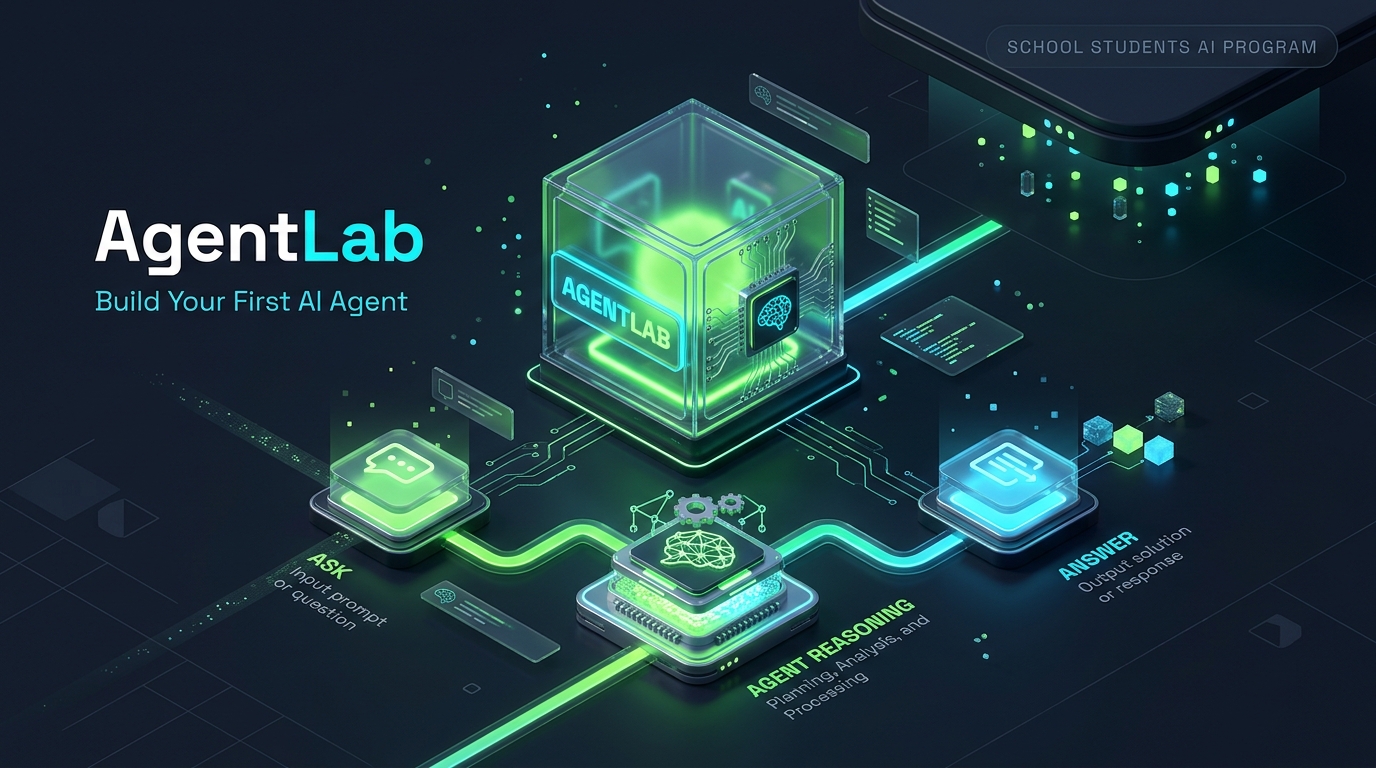
AgentLab is a hands-on AI training program where students build their first AI agent — a smart software tool that can search the web, do math, answer questions, and remember conversations.
Instead of just typing prompts into existing chatbots, students learn how to be the architects. They connect visual logic nodes, bind real web tools, structure memory, and deploy a system that thinks, decides, and acts on its own.
The 3-Step Autonomous Loop
Ask
Student Question / PromptThe user inputs a query or homework question requiring research, math calculation, or concept explanation.
Agent
Thinks, Decides & ActsThe agent analyzes the request, chooses the right tool (web search, calculator, or memory), and verifies the facts.
Answer
Real, Useful OutputReturns a helpful, step-by-step tutorial response with accurate math, verified sources, and clear explanations.
In just 9 days, students will:
“Not magic. Just logic.”
Every AI agent students build in AgentLab follows clear, understandable rules — demystifying artificial intelligence from day one and turning passive tech consumers into active creators.
Why AgentLab Matters
Traditional computer science classes teach static syntax. AgentLab introduces students to autonomous agent architecture, logic systems, and real-world tools that tech companies use today.
Future-Ready
AI skills are in-demand
AI literacy is becoming as essential as reading and math. Students build real intuition for how agentic software works before entering high school.
Hands-On
Learn by building, not just listening
50% theory, 50% live building. No passive lectures—every student designs real workflows, configures tools, and tests live agents in every single session.
Certified
A real credential for resume / LinkedIn
Earn a verified completion certificate backed by Foxkrit AI Consulting that demonstrates practical AI agent building skills early in their academic journey.
Practical
Build something you can use immediately
Students walk away with a personalized Homework Helper Agent that actually helps them study, summarize lessons, and solve problems every day.
Your 9-Day Learning Path
A carefully phased journey transitioning students from theoretical fundamentals to building, testing, and demonstrating a fully functioning AI agent.
Foundations · Days 1–5
AI Demystified
Understand the foundation—AI isn't magic, it's logic.
Build Your First Workflow
Learn how agents think and act independently.
Prompts & Architecture
Talk to AI effectively—the art of precise communication.
Master n8n Tools
Meet the tools—one day of theory, then we build.
Smart Logic & Safety
Theory ends here—building begins now. Learn by doing.
Ready to Build
By Day 5, students understand exactly how AI agents think, decide, and act — fully prepared to architect the capstone agent in Phase 2.
Project Build · Days 6–9
Core Agent Build
Expand your agent's capabilities—layer by layer.
Ethics & Responsibility
Give your agent memory—watch it learn and adapt.
Advanced Features
Polish your creation—make it production-ready.
You're an AI Practitioner
You built it. Now make it live. And explore where this takes you.
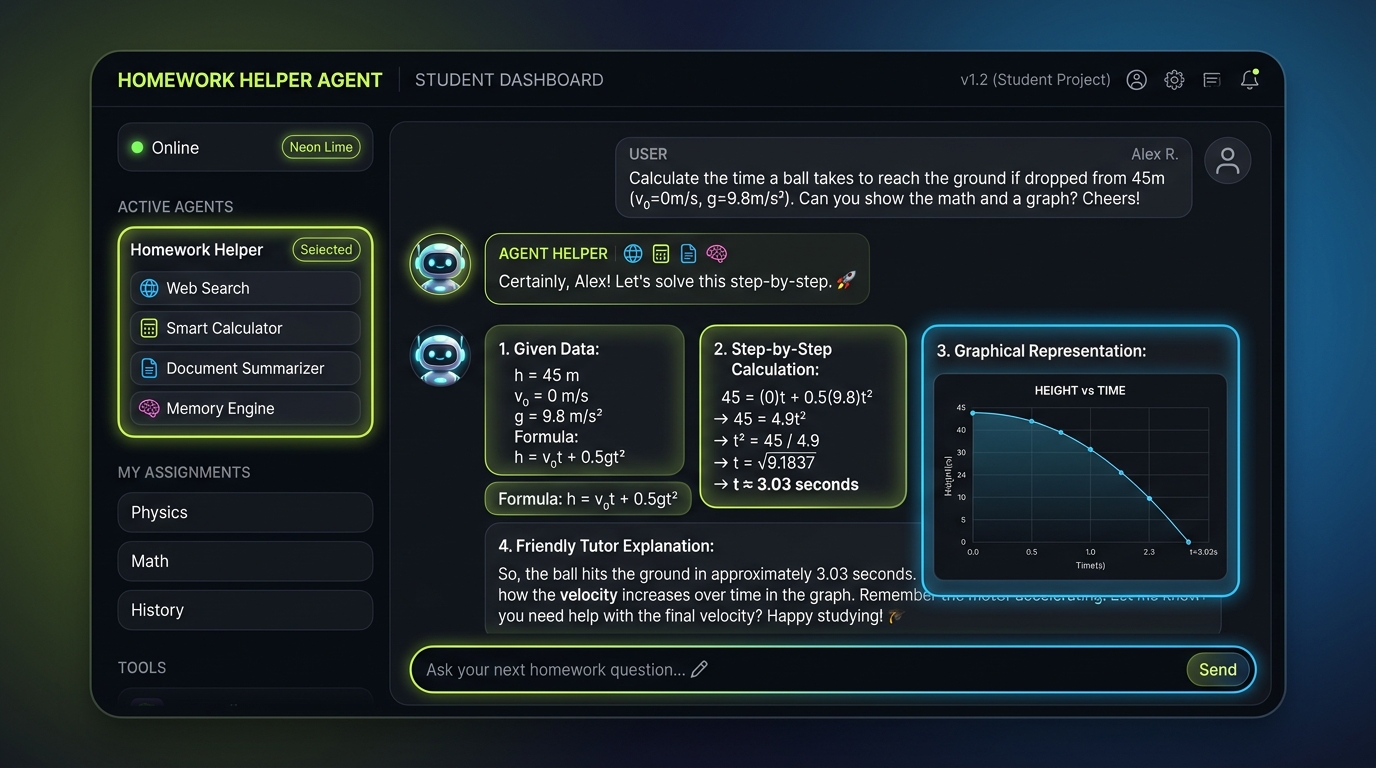
Homework Helper Agent
A multi-tool AI assistant that answers questions, searches the live web, calculates math and physics, summarizes long texts, remembers student context, and explains concepts patiently like a tutor.
By Day 9, every enrolled student will have a live, working agent they designed and built themselves.
Live Web Search
Searches the web for up-to-date facts, historical records, and research sources.
Step-by-Step Calculator
Solves math and physics equations, showing intermediate formulas and logic.
Text & Document Summarizer
Condenses long textbook chapters, articles, and reading assignments into bullet points.
Conversation Memory
Remembers the student's name, grade level, strengths, and ongoing discussions.
Socratic Tutor Persona
Never just gives the answer—guides the student through hints and concept breakdowns.
What You'll Gain
Every skill compounds: prompt engineering, workflow logic, and ethics all show up in the final certificate project.
Build a Real AI Agent from Scratch
Hands-on experience connecting triggers, logic, tools, and output channels.
Understand LLMs & Prompting
Learn how large language models process instructions and control outputs.
Deploy & Test a Working System
Publish a functional assistant to the cloud and test real queries.
Master Workflow Automation (n8n)
Use the visual orchestration platform used by modern AI startups.
Apply Ethical AI Principles
Build safe, trustworthy AI with guardrails, citations, and privacy in mind.
Resume & LinkedIn Ready Credential
An industry-recognized certificate validating hands-on AI competency.
Skills Developed Across AgentLab
Build
Design logic, configure tools, and write custom prompts in n8n.
Deploy
Turn visual workflows into live, responsive cloud-hosted agents.
Present
Showcase working agents to peers, teachers, and earn certificates.
Why Schools Should Offer AgentLab
AgentLab bridges the gap between academic theory and practical technology, equipping students with real-world capabilities while establishing the school as an AI pioneer.
For Students
For Schools
“Learned more in 9 days than an entire semester.”AgentLab Student Cohort Feedback
AgentLab: Build Your First AI Agent
Ready to empower your students with real Agentic AI skills? Contact us to book an AgentLab cohort for your school.
Learn AI. Build Projects. Change Your Future.